THEATRE REVIEW
NOVEMBER 2026 | Volume 269
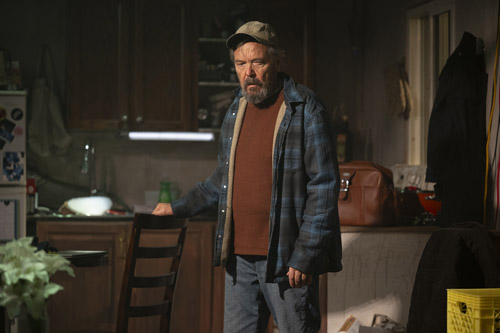
Tom McBeath by David Cooper.
Epigone
By Kevin Kerr
Electric Company Theatre
Downtown Eastside Heart of the City Festival
Russian Hall, 600 Campbell St.
Nov. 4-15
Sold Out
www.electriccompanytheatre.com
Any Electric Company show is going to be a highlight of the theatrical year and this one is no exception. The Electrics always present richly complex original plays full of visual and sonic fireworks, conceived by some of this country’s most talented artists. Their bar is set very high.
Drawn from Greek tragedy and playwright Kevin Kerr’s profound experience of his sister’s death, as he explains in a program note (https://www.electriccompanytheatre.com/playwrights-note-for-epigone-kevin-kerr/), Epigone focuses on both a woman’s life leading up to her death by drug overdose and her brother’s attempt to make sense of it. Kerr’s spiritual and practical dilemma—“how to care for our dead”—infuses the entire enterprise.
Directed by Jonathon Young, Epigone stars the luminous Colleen Wheeler as Laine, a woman living “in exile” in a remote cabin during an unspecified plague-like epidemic that looks like COVID. When the play opens, Laine is already dead. Her earnest brother James (Kevin MacDonald) has come to gather her things and clean out the cabin.
The first act introduces Laine’s grubby, eccentric neighbour and would-be boyfriend Stoney (Tom McBeath), who we first suspect must have been exploiting her but later realize he had genuinely tried to help her; and niece Angela (Lili Beaudoin), who sets up a shrine and presides over a ceremony to “help [Laine] passage” to the other side.
The second act flashes back to Laine’s final days. She shares her cabin with another druggie, Misty (Beaudoin again), whom Laine treats as her “kid” and tries to save, while despairing over her own life. As James tries to pull her back from the abyss, we learn how and why Laine is “pursued by the Furies of guilt and shame” and the dark shadows of family and fate that precede Laine’s own original sin.
Laine was a dressmaker, and is desperate to atone for her failure to finish a promised wedding dress from twenty years earlier. A line of white dresses strung across the shabby cabin resembles a collection of classical Greek statuary. James, a theatre producer, has this idea that he and Laine should stage a Greek tragedy called Epigone that will somehow purge the family curse, allay the Furies, and redeem their lives.
There’s a lot here to unpack. But first let me say that Wheeler is fantastically compelling. She makes it utterly believable that Laine is being eaten alive by her private Furies. Also appearing briefly in the first act as Laine’s feuding neighbour, Wheeler shows how comfortably she can wear either the comic or tragic mask.
The rest of the cast is also very fine. McBeath makes Stoney funny, edgy, needy, and ultimately compassionate without slipping into sentimentality. Beaudoin is terrific, keeping Angela’s first act pagan ceremony from feeling too woo woo, and giving the otherwise hopeless Misty enough humanity to make her worth Laine’s attempt at salvation. MacDonald’s James, Kerr’s portrait of the artist as himself, always feels out of his depth but never stops trying to save the sister he clearly deeply loves.
Eric Chad’s constantly shifting lighting and video design is almost a character in itself, and Kate De Lorme’s sound also helps animate the play’s liminal world spanning the living and dead.
Although full of powerful moments, neither the play nor production is entirely successful. Kerr hasn’t quite worked out how to integrate the tragic elements into the play’s otherwise realist world. He clumsily introduces a convenient family album near the end that feels like a melodramatic contrivance. And as much as I appreciate that Kerr wrote this play to explore and treat his own trauma in the wake of his sister’s death, the device of James’ meta-notion—that he and Laine could create a ritualistic Greek tragic play that would heal Laine’s deep, searing emotional wounds—seems dramatically weak.
The staging in the Russian Hall had, unfortunately, serious sight-line problems. The seating was such that anyone higher than about the third row couldn’t see the forestage area of Paula Viitanen’s set where some of the most important moments of the play took place.
Give the script one more draft and the production a more expansive theatre space. Meanwhile, every performance of this run has sold out.
get in touch with vancouverplays:
vancouverplays
Vancouver's arts and culture website providing theatre news, previews and reviews