THEATRE REVIEW
MARCH 2026 | Volume 261
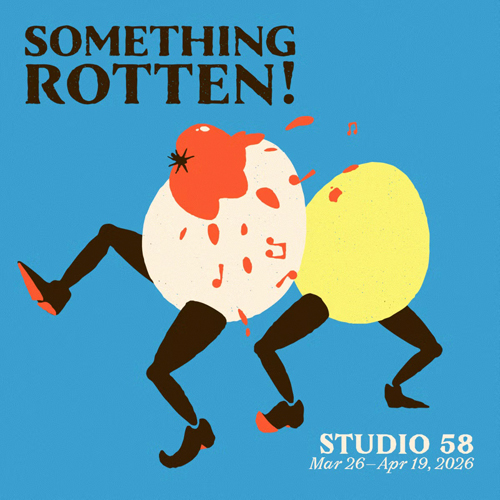
Something Rotten
Book by Karey Kirkpatrick and John O'Farrell
Music and lyrics by Wayne and Karey Kirkpatrick
Studio 58, Langara College
Mar. 26-April 19
From $25
www.studio58.ca or 604-323-5227
BUY TICKETS
Imagine being a playwright in London while Shakespeare is penning his Richard III next door. While history says that The Bard was just one of many popular bards during his time, Shakespeare’s enduring presence makes it hard to believe that his peers wouldn’t have envied him. In Studio 58’s production of the 2015 Broadway musical Something Rotten, director Dean Paul Gibson creates the thriving theatre industry of 16th century London with a small set and a big cast. While some actors in the production could use more enthusiasm to match the musicality, others excel in welcoming you to the Renaissance.
Created by brothers Karey and Wayne Kirkpatrick, Something Rotten is more Shakespearean than some of The Bard’s own work: two brothers, Nick and Nigel Bottom, come from Cornwall in search of fortune in the theatre industry. Nick, the idea man, leads his younger brother, Nigel, the poet/writer, as they look for new ideas. While Nick wants profits, the latter wants to write from his heart. Then come romantic entanglements: Nick’s wife Bea insists on making money so her husband can produce a play, which only adds pressure on him. Poor Nigel falls for a Puritan’s daughter who tells him to follow his heart. Shylock tries to convince Nick to borrow money for his play while Nostradamus, the stand-in for the quintessential magical force in Shakespeare plays, predicts with questionable precision that musicals will be the next big thing in theatre. When asked by Nick about Shakespeare’s biggest play, Nostradamus knows it is something like an omelette.
A play that is both Shakespearean and a musical actively questions the divide between high and low culture. Something Rotten doesn’t just use metacommentary to explain what musicals are, that is, actors dancing and singing instead of delivering soliloquies for an audience that would rather have fun than be intellectually challenged.It also shows why musicals – with their complex choreography and layered direction – deserve their place in the history of theatre. Choreographed by Nicol Spinola, the unexpectedly professional tap-dancing sequences are some of the best parts of the play, showing that plot twists aren’t always tethered to the script. The same is true of the egg-costumed sequences.
Along with the co-existence of Shakespeare and musicals in this play, the real work falls on the shoulders of actors who play 16th century characters with the inner monologues of 21st century Shakespearean critics and the joviality of 20th century musical performers. Despite the difficult task, some clearly go above and beyond. Nigel, played by Kobe Lim, is the heartbeat of the play. He earns sympathy as the tragic hero without letting the musical hit a low note. Joel Bakajika, who plays Nostradamus, brings exceptional energy for a small theatre space and takes the play to its highest point.
Portia (Payton Gowdar) and Bea (Saidi Mader) are the perfect Shakespearean women: resolute, dramatically funny but devout lovers. Portia and Nigel’s chemistry iscompelling. While Daniel Marte,as the minstrel, opens the play, Bea’s perfect pitch in the second song, “Right Hand Man,” really sets the tone for the musical.
Lastly, William Shakespeare, played by Evan Andersen Sterns, a Prince-like pompous rockstar, steals the show. Sterns’ excellent presence should also be credited to his leather costume, a ruff collar, fake moustache and beard for disguise scenes (costume design by Donnie Tejani), and to voice and dialect coach Brad Gibson for The Bard’s flamboyant Englishness.
Intentionally or not, the audience can see the band play on top of the set. Musical director and band leader Sean Bayntun is visible to the audience as he orchestrates the whole play on his keyboard. This adds to the theatricality of a play with so many historical dimensions. Shizuka Kai’s set design includes two-sided flats that turn around to show the outdoor and indoor settings equally well without congesting the stage.
Something Rotten’smost notable achievement is blending the intellectual discourse about Shakespeare’s popularity – for example, questioning the difference between intellect and emotions itself — while somehow packing in a gazillion punchlines. The production manages to deliver most of those in an intimate theatre space with gusto.
Reviewed by Aadya Arora
get in touch with vancouverplays:
vancouverplays
Vancouver's arts and culture website providing theatre news, previews and reviews